
ChemiSense Amine Residual Sensor Field Kit for Corrosion Inhibitors
Routine lab analysis can delay critical decisions. Now, obtain accurate amine residual data of your corrosion inhibitors in the field within six hours using the patent-pending ChemiSense Amine Residual Sensor Field Kit.
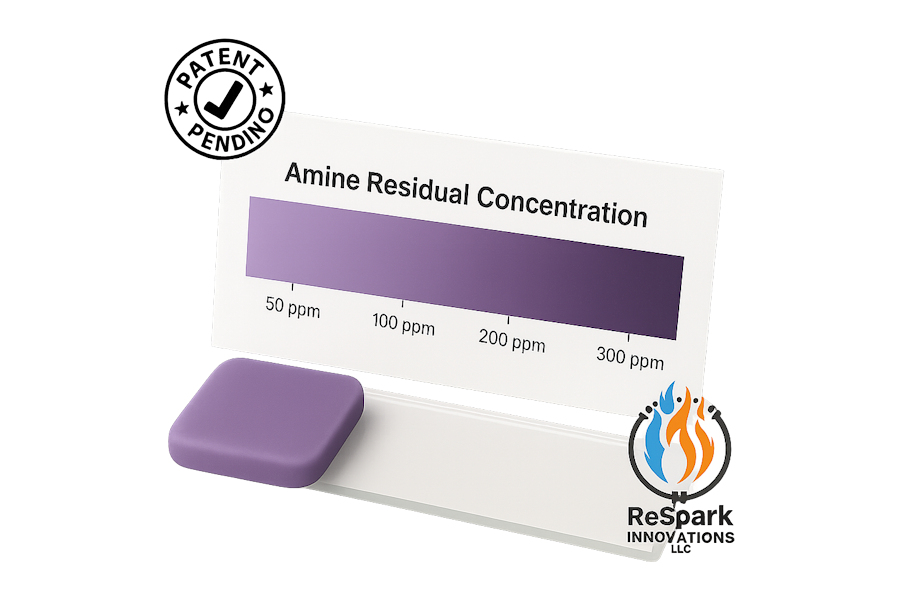
Fast, Accurate Amine Residual Testing of Corrosion Inhibitors.* Right in the Field.
Routine lab analysis can delay critical decisions. Now, obtain accurate amine residual data of your corrosion inhibitors in the field within six hours using the patent-pending ChemiSense Amine Sensor System.*
This portable, self-contained test kit provides measurable, repeatable results that allow for same-day system adjustments and optimized inhibitor dosing without waiting for tedious laboratory turnaround.
Key Advantages
- Reliable results in <6 hours.
- Eliminates shipping and lab delays.
- Enables on-site monitoring and rapid corrective action.
- Compact, easy-to-use design with minimal training required.
Procedure
- Collect your sample, ensuring a visible water phase.
- Immerse the provided sensor film for at least one minute.
- Transfer the film to the clean, dry container for up to six hours.
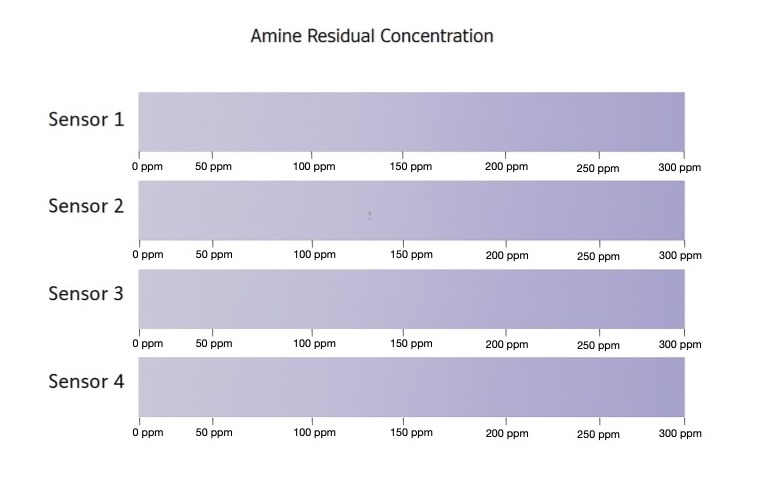
- Compare the developed film color to the provided calibration scale to determine inhibitor concentration.

Facts About the Amine Residual Sensor Field Kit
- Sensor response: accurate from 0 to 300 ppm at 25 to 50 ppm intervals.
- Applications: primary and secondary amine corrosion inhibitors or low-level concentrations in process plants.
- Reproducible results.
- Maximum response time for low levels is 6 hours at 70°F. Higher temperatures will respond faster.
- Higher concentrations of amine respond faster than maximum time.
- Minimum exposure time to sample is 1 minute.
- Demonstrated no interference in crude or produced water.
Simple. Fast. Reliable.
Expected to perform with the following corrosion inhibitors:
- Nalco Products: NALCO 359, EC1021A, 5196 (EcoLab)
- ChampionX Products: CORR11540W, CORR11509A
- Baker Hughes Products: RediDirect RTT1600, RTT1500, RTT1300, RTT1400, CRW132, TOPGUARD Overhead Corrosion Control
FAQs
What does the ChemiSense™ Amine Sensor System actually measure?
It measures residual concentrations of primary and secondary amine inhibitors in a sample, expressed in ppm (parts per million).
Does it work for all amine types?
No. It is designed and validated for primary and secondary amines only (such as MEA). It does not work with tertiary amines.
How long does the test take?
You can obtain accurate results within 6 hours, depending on amine concentration and temperature. Higher concentrations or higher temperatures produce faster results.
What’s the minimum exposure time to the sample?
At least 1 minute.
How accurate is the test?
The sensor provides reproducible results from 0–300 ppm, with calibration intervals of 25–50 ppm.
Do I need lab equipment to use this kit?
No. The system is self-contained and portable—no external lab tools or analyzers are required.
How do I interpret the color results?
Compare the developed film color against the included calibration scale to determine amine concentration.
Does temperature affect the response time?
Yes. The specified 6-hour maximum response is at 70°F (21°C). Warmer conditions produce faster color development.
What if my process stream has other chemicals present?
There are no known interferences, the sensor is only sensitive to primary and secondary amines. Contact us if an interference is a concern.
Can I reuse the sensor film?
No. Each film is single-use only for one test.
What happens if the film dries during exposure?
Ensure the film remains immersed for the full minute. Drying during exposure time may increase the reaction time.
Is the calibration chart affected by lighting or aging?
Yes. Always view color under consistent lighting and use the provided chart.
What’s the shelf life of the sensor films?
Shelf stability is still being tested. Current recommendation: use within 2 months of receiving.
How should I store the test kit?
Keep at room temperature, away from direct sunlight or high humidity.
Can I refrigerate the sensors to extend shelf life?
Yes, cooler temperatures extend stability of the sensor. We are still testing shelf stability.
Are there any disposal requirements?
Dispose of used films and sample residues according to your facility’s chemical waste procedures.
Is training or certification required to use the kit?
No formal training required. The kit comes with easy instructions.
Can I use this kit for continuous monitoring?
It’s designed for batch or spot testing, not continuous monitoring. ReSpark is currently developing a continuous monitoring technology. If amine concentration increases, the sensor will continue to respond to higher levels but will not respond to levels lower than previously measured.
What do I do if my film color doesn’t match the chart?
If color appears inconsistent or outside the range, retest with a fresh film and verify sample handling steps.
What if I’m testing a different inhibitor type?
Contact ChemiSense support to discuss compatibility or future sensor variants.
Will you offer digital color reading or app support in the future?
A digital companion app for automatic color quantification is under evaluation. Stay tuned for updates.
Can I use this in high-pressure or high-temperature lines directly?
It is not currently capable of inserting into high-pressure lines. Collect a representative sample before testing. The sensor has been successfully tested to 200°F.
What’s included in the kit?
Each kit includes sensor films, calibration chart, sample container, drying container, and user instructions.